“Which app was I using?”
Tool switching
The work may be in email, a spreadsheet, chat, cloud storage, or a task app. Remembering the location becomes work before the work.
Stelaah keeps your clients, projects, files, messages, contracts, and invoices connected, so losing focus doesn’t mean losing the work.
Fewer places to search. Fewer things to remember. Fewer chances to lose momentum.
ADHD can affect attention, organization, working memory, task initiation, time management, and follow-through. Experiences vary. These are recurring business moments, not a checklist for diagnosis.
Tool switching
The work may be in email, a spreadsheet, chat, cloud storage, or a task app. Remembering the location becomes work before the work.
Lost momentum
An interruption can erase the mental thread. Returning means reconstructing the goal, the last decision, and the next move.
Search fatigue
A small billing action grows into a hunt for the client, estimate, time, terms, and latest status.
Task-initiation friction
The visible task is short. Finding the context, choosing the first action, and crossing the emotional threshold may not be.
Fragmented capture
Notes in several places reduce trust in every place. You still have to remember where future-you should look.
Priority fog
When deadlines and consequences are not visible together, every open loop competes at the same volume.
Restart cost
A rigid routine can turn one interrupted day into avoidance. A forgiving system keeps a believable path back.
Notification saturation
More alerts do not create more clarity when the prompt lacks the record, decision, or next action needed to begin.
Stelaah does not ask your brain to become a different brain. It gives the work a connected place to live, then helps bring the right context back when you need it.
Open one client and reach the connected projects, tasks, messages, files, contracts, estimates, and invoices. The relationship becomes the predictable doorway to the work. See Clients.
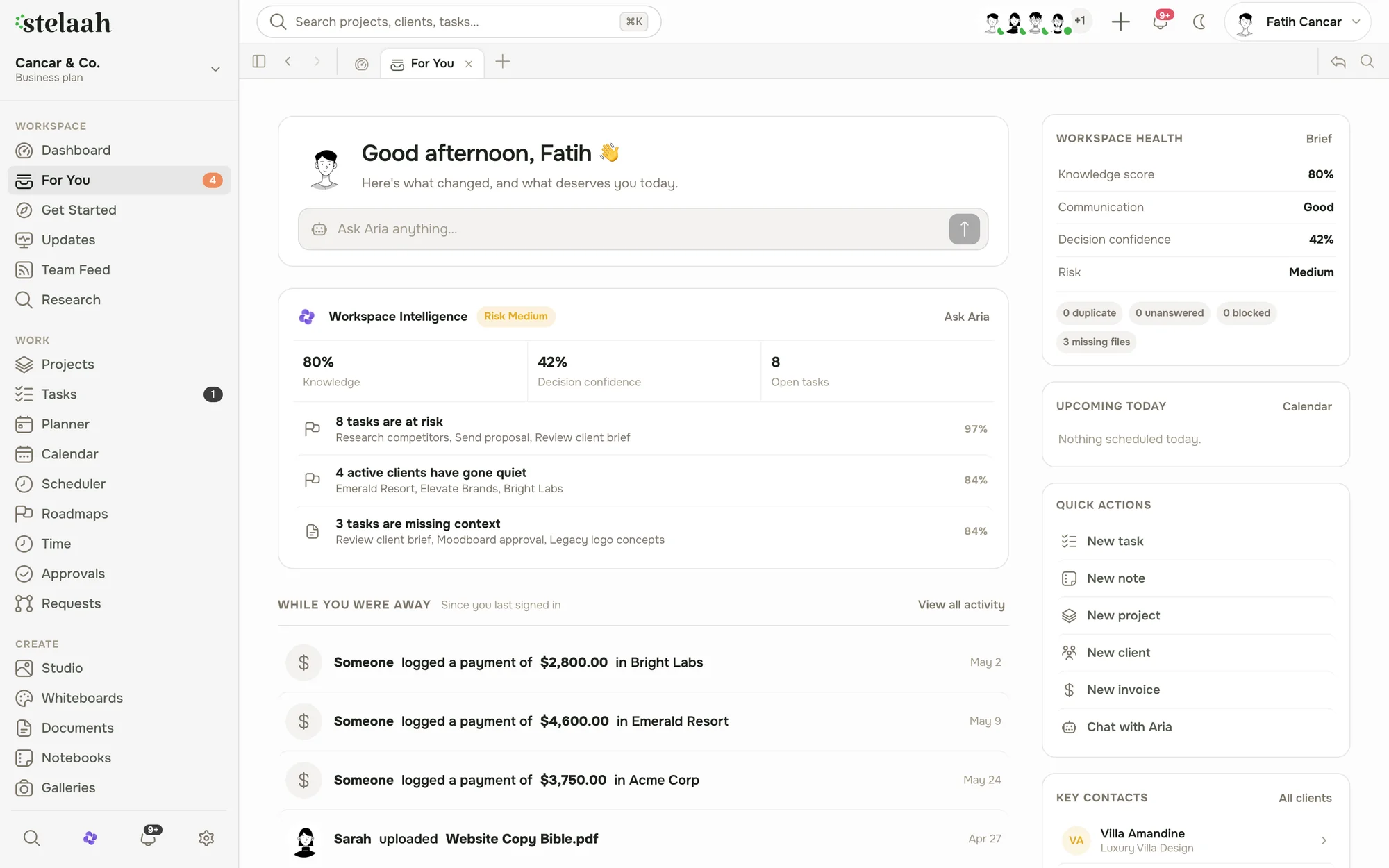
For You brings together what changed, what is at risk, and what needs you from real workspace records. It can reduce the morning scan across every open list. See For You.
Tasks stay attached to the project and client they move forward. Add the owner, real deadline, supporting file, and next action so returning does not require rebuilding the thread. See Tasks.
Contracts, accepted estimates, tracked time, invoices, payment status, and routine reminders remain connected to the client work that created them. See Invoices.
Suggestions can notice supported moments and prepare a next step for review, such as an invoice draft after an estimate is accepted or an editable recovery plan when related tasks become overdue. They are opt in, permission aware, reviewable, and undoable. See Automations and Suggestions.
Suggestions do not send invoices or move deadlines without approval. Stelaah can reduce routine friction, but it cannot decide what support is right for every person or replace clinical care.
Move one active client. Add the project and next steps you need this week. Attach the contract, files, messages, and invoice that govern the work. Use it before you expand it.
Focused help for the moments where attention, memory, administration, and client responsibility meet.
No. Stelaah is business software, not a diagnostic or treatment tool. It can reduce search, duplicate records, and routine follow-through steps, but it does not provide medical care.
No single setup suits everyone. Stelaah may help people who benefit from connected context, fewer places to search, and reviewable next steps. The best setup is the one you can understand, adjust, and return to.
No. Start with one active client and the current work. Expand only after that smaller setup is useful.
Suggestions are opt in, permission aware, editable, reviewable, and undoable. They do not send invoices or move deadlines without approval.
This page draws on established descriptions of adult ADHD and executive-function challenges from the National Institute of Mental Health, CHADD, and the Job Accommodation Network. Community discussions across r/ADHD, r/ADHD_Programmers, r/Entrepreneur, and r/smallbusiness informed the plain-language pain points. Those discussions are qualitative and are not evidence about how common an experience is.
For diagnosis, treatment, or personal health decisions, speak with a qualified healthcare professional.
Start with one client. Keep the work, decisions, files, and money connected, so coming back takes less reconstruction.